A “first” in Trappes? Fourteen years earlier, three Jewish children were murdered in Toulouse
Gabriel, Arié and Myriam were killed in Toulouse in 2012. How do court judgments and public tributes bear on Macron’s remarks in Trappes in 2026?
Read this article in: FrançaisEspañolItalianoעבריתالعربيةفارسیРусскийहिन्दी
Translated from French. Read the original.

On 23 October 2026, Emmanuel Macron spoke at Trappes town hall after shootings that morning in Trappes and La Verrière, in the Yvelines department. Pengo Bossio Wangi, 26, had been killed 16. Five people had been wounded, including a 12-year-old girl. The national counterterrorism prosecutor’s office had taken over the investigation. Speaking to elected officials from both towns, the president expressed support for the families and described the attack as both terrorist and racist 12.
Macron spoke of a “first”. He described a terrorist act planned “to kill our fellow citizens, our children, because of the colour of their skin or the religion others ascribe to them”. Video and full transcript from the Élysée. The religion he referred to was the one the perpetrator attributed to the victim. The president’s wording included adults 12.
Yonathan Arfi, president of the Representative Council of Jewish Institutions in France (Crif), expressed solidarity with the victims and asked the president to correct his statement. He recalled the names of the four people murdered at the Ozar Hatorah school in 2012, and that of Father Jacques Hamel, murdered in his church in Saint-Étienne-du-Rouvray in 2016. The Élysée told journalists the president had been thinking of targeting based on skin colour. That evening Macron acknowledged on X that Jews and Christians had previously been attacked precisely because of their religion 12.
In the Toulouse case, the courts established that the crimes had been planned, that they constituted terrorism and that the school victims had been chosen because of their religion. This selection of cases since 2000 allows us to compare presidents’ words, judges’ findings and families’ recollections 46101112.
A mobile phone salesman in Bagneux, three children in Toulouse
Ilan Halimi was 23 and sold mobile phones. In January 2006, a group led by Youssouf Fofana kidnapped him for ransom. His captors had chosen him because he was Jewish. They assumed this meant his family could pay. They held and tortured him in Bagneux. On 13 February he was found alive near the railway tracks in Sainte-Geneviève-des-Bois, in the Essonne department. He died on the way to hospital 34.
The trial examined both the plan to obtain a ransom and the choice of a Jewish victim. In July 2009, the Paris juvenile assize court, which had jurisdiction because some defendants had been minors at the time of the offences, sentenced Youssouf Fofana to life imprisonment. It expressly found antisemitism to be an aggravating circumstance 34.
Twenty years after Ilan’s death, on 13 February 2026, his family was received at the Élysée Palace. Macron recalled the young man’s age and the prejudice that had motivated his kidnapping. In the same speech he named the four victims at Ozar Hatorah and the four at the Hyper Cacher supermarket. An oak tree was planted in the palace garden in Ilan’s memory. Eight months separated that tribute from the statement at Trappes 134.
On Monday 19 March 2012 in Toulouse, Jonathan Sandler, 30, a rabbi and teacher at the Ozar Hatorah Jewish school, was waiting with his sons. Gabriel was three and Arié five. Myriam Monsonego, the headteacher’s daughter, was eight. Mohamed Merah killed all three children and Jonathan Sandler. Another pupil, Aaron Bijaoui, known as Bryan, was seriously wounded. He was 15. His name, too, was included in the tribute to the dead and wounded ten years later 56.
The school attack was the third in a series. On 11 March in Toulouse, Merah had killed a soldier, Imad Ibn Ziaten. On 15 March in Montauban, he killed soldiers Abel Chennouf and Mohamed Legouad and seriously wounded their comrade Loïc Liber. The courts distinguished the motive for targeting the soldiers, who were attacked as members of the armed forces, from the motive for selecting the victims at the school 56.
Mohamed Merah died during the police operation and never stood trial. His brother Abdelkader was tried. On 18 April 2019, the special assize court in Paris sentenced him on appeal to 30 years in prison, including for complicity in terrorist murders and attempted murders. On 22 April 2020 the Court of Cassation dismissed his appeal. Its judgment states that the trial judges had established that he knowingly helped prepare the crimes. In the school case the conviction also reflected the choice of victims on the grounds of religion 56.
On 20 March 2022 in Toulouse, Macron commemorated the attacks with Israeli President Isaac Herzog. Nicolas Sarkozy and François Hollande were present. Macron named the three children, Jonathan Sandler, the three soldiers killed and the two people wounded. He also recalled why Gabriel and Arié had been standing outside the school where their father taught. It was where the bus picked them up for school every morning 5.
Créteil and Porte de Vincennes: why these victims?
On 1 December 2014 in Créteil, Jonathan B. and his partner, Laurine C., were at his parents’ flat. Three men entered, tied them up and searched for money. Laurine was raped. At the hearing, the couple recounted how the assailants referred to Jonathan’s Jewish family as they demanded money. On 6 July 2018, the Val-de-Marne assize court found that antisemitism had motivated the choice of victims. It convicted Ladje Haidara of the rape. The other two assailants were Houssame Hatri and Abdou Salam Koita 7.
On 9 January 2015, Amedy Coulibaly took hostages at the Hyper Cacher supermarket at Porte de Vincennes in Paris. He had chosen a kosher business in order to attack Jews. The four men he killed were Yohan Cohen, 20, Yoav Hattab, 21, Philippe Braham, 45, and François-Michel Saada, 63. Yohan worked in the shop. The other three were customers. All four names appear on its plaque, which explicitly identifies the attack as antisemitic. Coulibaly was killed when police stormed the building 8.
On 16 December 2020, at the trial over the attacks of January 2015, the special assize court explicitly acknowledged the antisemitic nature of the attack. On the charge of unlawful confinement, it explained that the rules in force in January 2015 prevented it from applying the aggravating circumstance of religion in the conviction. The motive nevertheless appears in the court’s written reasons 9.
Ten years after the attack, on 9 January 2025, ten candles were lit outside the supermarket. Yohan’s father helped light the first. François-Michel’s sister helped light the fourth. Other lights commemorated the victims of the attack on Charlie Hebdo’s editorial staff and the police officers killed in January 2015. Relatives, neighbours, ministers and religious representatives attended. At this public ceremony, some participants also spoke of how alone they felt in the face of antisemitism 8.
What the courts found in Paris, Courbevoie and Levallois
On 4 April 2017 in Paris, Sarah Halimi, 65, was killed at home by her neighbour Kobili Traoré. The investigating chamber of the Paris Court of Appeal found sufficient evidence to attribute the killing to him and to link it to the victim’s Jewish faith. It examined his words and psychiatrists’ findings about the part his neighbour’s Judaism played in his delusions. On 19 December 2019, it declared that he could not be held criminally responsible because he had lost all capacity for discernment at the time. It ordered his admission to hospital as an inpatient 10.
The family challenged the outcome, in particular the weight given to Traoré’s voluntary cannabis use. The experts agreed he had experienced an acute psychotic episode but differed on its implications for criminal responsibility. On 14 April 2021, the Court of Cassation dismissed the appeals. It noted that the law then in force made no distinction according to the cause of the disorder that had destroyed his capacity for discernment. Both findings of the investigating chamber stood: the killing was antisemitic and Kobili Traoré could not stand trial at an assize court 10.
On 23 March 2018, Mireille Knoll, 85, was killed in her Paris flat. On 10 November 2021, the Paris assize court convicted Yacine Mihoub of her murder. It found that her vulnerability and her Jewish faith constituted aggravating circumstances. Mihoub was sentenced to life imprisonment. His co-defendant, Alex Carrimbacus, was acquitted of murder and sentenced to 15 years for aggravated theft. Mihoub appealed, then withdrew his appeal, making the conviction final 11.
On 15 June 2024 in Courbevoie, a 12-year-old Jewish girl was raped and subjected to antisemitic insults. On 13 June 2025, the Nanterre juvenile court found two boys guilty of gang rape and a third of complicity. It found that the victim had been targeted because of her religion. The two perpetrators were sentenced to nine and seven years in prison. For the accomplice, who was under 13 at the time, the judges ordered a five-year educational measure including placement in care and treatment 1218.
Only one of the three appealed. On 18 November 2025 in Versailles, the court reduced his sentence from nine to seven years and upheld his conviction, including the aggravating circumstance relating to the victim’s religion 12.
On 13 October 2024 in Levallois-Perret, a 15-year-old boy wearing a kippah was assaulted near Pont de Levallois metro station. At the trial of Mohamed K., 18, the defence admitted extortion but disputed antisemitism. The defendant said he had not seen the kippah. The teenager also reported that his assailants had addressed him by reference to his religion. The Nanterre criminal court upheld the aggravating circumstance and imposed a two-year prison sentence, with six months suspended subject to probation 13.
Two figures for 2025 that answer different questions
In 2025 the Interior Ministry recorded 1,320 antisemitic acts. The same number appears in the records of the Jewish Community Protection Service (SPCJ), which works with the ministry, and in the report of the National Consultative Commission on Human Rights (CNCDH). Estimates put Jews at less than 1% of the French population. To read these figures together, we need to know which incidents the agencies count 1415.
In its tally of anti-religious incidents, the ministry lists 1,320 antisemitic, 843 anti-Christian and 326 anti-Muslim acts. Of these 2,489 incidents, 53% were antisemitic 17. In the territorial intelligence service’s figures for racist and xenophobic incidents, published by the CNCDH, the other two categories are anti-Muslim incidents and other racist or xenophobic incidents. The total is 3,289, of which the same 1,320 antisemitic acts account for 40.1% 1415.
These records cover property damage, assaults and threats. One incident can affect several people, and some incidents go unreported. It is possible to compare the share of recorded incidents with the estimated share of the population. Calculating an individual’s risk of assault would require knowing how many people were affected 1415.
Chronology
- 2006-02-13 — Ilan Halimi dies after being held captive in Bagneux 34.
- 2012-03-19 — At the Ozar Hatorah school, Mohamed Merah kills Jonathan, Gabriel and Arié Sandler and Myriam Monsonego. Aaron Bijaoui is wounded 56.
- 2014-12-01 — Jonathan B. and Laurine C. are attacked in the family flat in Créteil 7.
- 2015-01-09 — In Paris, Amedy Coulibaly kills four men at the Hyper Cacher supermarket 8.
- 2017-04-04 — Kobili Traoré kills Sarah Halimi in Paris 10.
- 2018-03-23 — Yacine Mihoub kills Mireille Knoll in Paris 11.
- 2024-06-15 — A 12-year-old girl is raped in an antisemitic attack in Courbevoie 12.
- 2024-10-13 — A 15-year-old boy is assaulted in an antisemitic attack in Levallois-Perret 13.
- 2026-10-23 — After the attack in Trappes and La Verrière, Macron speaks in Trappes and later publicly acknowledges earlier antisemitic and anti-Christian attacks 12.
What this tells us
In Toulouse in 2022, Macron named the children whose fate contradicts his wording in Trappes in 2026 156. At Porte de Vincennes, a single ceremony honoured the Jewish victims, the police officers and those killed at Charlie Hebdo, while some participants spoke of feeling alone 8. Yonathan Arfi’s criticism concerns the place that the word “first” assigns to Trappes in French history. It is possible to verify the substance of his objection on religious targeting while acknowledging, as he did, what the residents of Trappes and La Verrière endured 126.
For further reading, see the history of the Protocols of the Elders of Zion and our report on Kristallnacht commemorations in Europe.
Sources
- Élysée, « Déplacement à Trappes » (vidéo et transcription), 23 octobre 2026, https://www.elysee.fr/emmanuel-macron/2026/10/23/deplacement-a-trappes
- Le Monde, direct de Trappes et de La Verrière, rubrique sur la réaction du Crif et la réponse de l’Élysée, 23–24 octobre 2026, https://www.lemonde.fr/societe/live/2026/10/23/en-direct-tirs-a-trappes-et-a-la-verriere-ce-qu-il-s-est-passe-aujourd-hui-est-un-tournant-dans-la-vie-de-notre-republique-declare-emmanuel-macron-qui-denonce-un-attentat-terroriste-raciste_6799092_3224.html
- Élysée, « Cérémonie d’hommage à Ilan Halimi » (vidéo et discours), 13 février 2026, https://www.elysee.fr/emmanuel-macron/2026/02/13/ceremonie-dhommage-a-ilan-halimi
- Le Monde, « Le procès du “gang des barbares” : perpétuité pour l’assassin d’Ilan Halimi », 11 juillet 2009, https://www.lemonde.fr/a-la-une/article/2009/07/11/le-proces-du-gang-des-barbares-perpetuite-pour-l-assassin-d-ilan-halimi_1217829_3208.html
- Élysée, « Commémoration des dix ans des attentats de Toulouse et Montauban », 20 mars 2022, https://www.elysee.fr/emmanuel-macron/2022/03/20/commemoration-des-dix-ans-des-attentats-de-toulouse-et-montauban
- Cour de cassation, chambre criminelle, arrêt du 22 avril 2020, pourvoi n° 19-83.475, Légifrance, https://www.legifrance.gouv.fr/juri/id/JURITEXT000041845606
- Le Monde, « Agression antisémite à Créteil : des peines de prison ferme de huit à seize ans », 6 juillet 2018, https://www.lemonde.fr/police-justice/article/2018/07/06/agression-antisemite-a-creteil-des-peines-de-prison-ferme-de-huit-a-seize-ans_5327481_1653578.html
- Le Parisien, « Dix ans après l’attentat contre l’Hyper Cacher, le recueillement et l’inquiétude face à l’antisémitisme », 9 janvier 2025, https://www.leparisien.fr/faits-divers/dix-ans-apres-lattentat-contre-lhyper-cacher-le-recueillement-et-linquietude-face-a-lantisemitisme-09-01-2025-A7VH6LAYKBHVHLXLOGUC3OFLLU.php
- Le Monde, « Verdict au procès des attentats de janvier 2015 », réponse sur la feuille de motivation de la cour, 16 décembre 2020, https://www.lemonde.fr/societe/live/2020/12/16/attentats-de-2015-suivez-en-direct-le-verdict-du-proces-devant-la-cour-d-assises-speciale-de-paris_6063606_3224.html
- Cour de cassation, chambre criminelle, arrêt du 14 avril 2021, pourvoi n° 20-80.135, Légifrance, https://www.legifrance.gouv.fr/juri/id/JURITEXT000043473408
- AFP, « Meurtre de Mireille Knoll : il n’y aura pas de procès en appel », The Times of Israël, 10 janvier 2023, https://fr.timesofisrael.com/meurtre-de-mireille-knoll-il-ny-aura-pas-de-proces-en-appel/amp/
- Le Parisien, « Viol antisémite d’une fille de 12 ans à Courbevoie : peine réduite en appel pour l’un des accusés », 18 novembre 2025, https://www.leparisien.fr/hauts-de-seine-92/viol-antisemite-dune-fille-de-12-ans-a-courbevoie-peine-reduite-en-appel-pour-lun-des-accuses-18-11-2025-5PGY57FQ4ZBCJFQYUIRTE3GSAM.php
- Le Parisien, compte rendu du procès pour l’agression d’un adolescent à Levallois, 25 octobre 2024, https://www.leparisien.fr/hauts-de-seine-92/votre-volonte-cetait-de-casser-du-juif-deux-ans-de-prison-pour-lagression-dun-adolescent-a-levallois-25-10-2024-HQDX4LAWXVFGNATI7G7Z75G6JM.php
- CNCDH, Les Essentiels du rapport 2025 sur la lutte contre le racisme, l’antisémitisme et la xénophobie, juin 2026, notamment p. 9–11, https://www.cncdh.fr/sites/default/files/2026-06/CNCDH%20Essentiels%20du%20rapport%20racisme%202025.pdf
- Service de protection de la communauté juive (SPCJ), « Les chiffres de l’antisémitisme en France en 2025 », bilan diffusé en février 2026, https://www.spcj.org/antisemitisme/chiffres-de-l-antisemitisme-2025
- Hommage de l’Assemblée nationale, https://presidence.assemblee-nationale.fr/activites/discours/50913
- Ministère de l’Intérieur, bilan 2025, https://www.interieur.gouv.fr/actualites/communiques-de-presse/publication-du-bilan-national-detaille-des-actes-antireligieux-2025
- Le Monde, audience de première instance, https://www.lemonde.fr/societe/article/2025/06/14/elle-n-aurait-pas-ete-violentee-ni-violee-si-elle-n-avait-pas-ete-juive-deux-mineurs-condamnes-a-neuf-et-sept-ans-de-prison-pour-le-viol-a-caracere-antisemite-d-une-jeune-fille-de-12-ans-a-courbevoie_6612961_3224.html
The story in 30 seconds
Read the main facts at a glance and share the link.
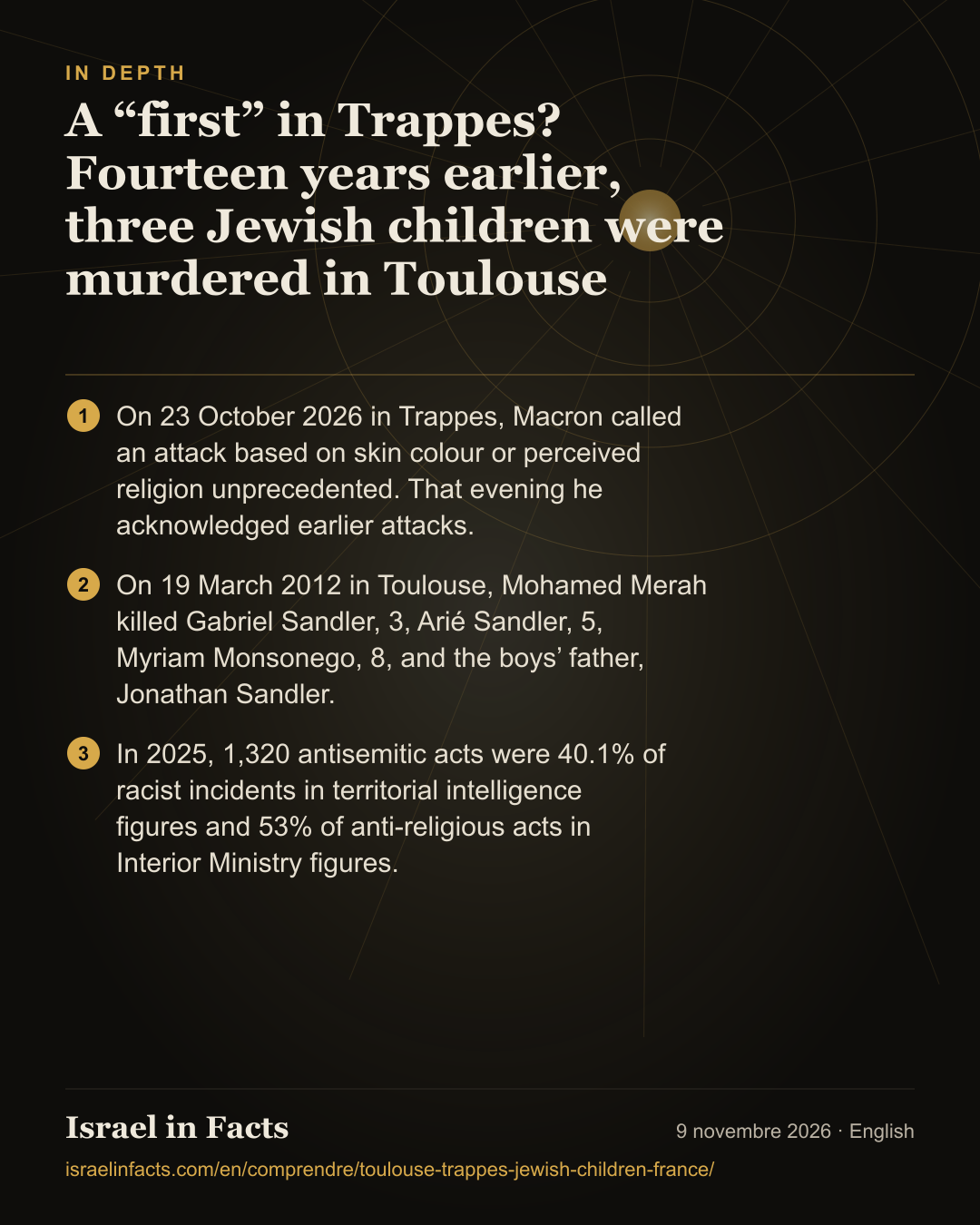
- On 23 October 2026 in Trappes, Macron called an attack based on skin colour or perceived religion unprecedented. That evening he acknowledged earlier attacks.
- On 19 March 2012 in Toulouse, Mohamed Merah killed Gabriel Sandler, 3, Arié Sandler, 5, Myriam Monsonego, 8, and the boys’ father, Jonathan Sandler.
- In 2025, 1,320 antisemitic acts were 40.1% of racist incidents in territorial intelligence figures and 53% of anti-religious acts in Interior Ministry figures.
Spotted an error or a missing source? Write to us : we publish corrections in the article.
Related reading
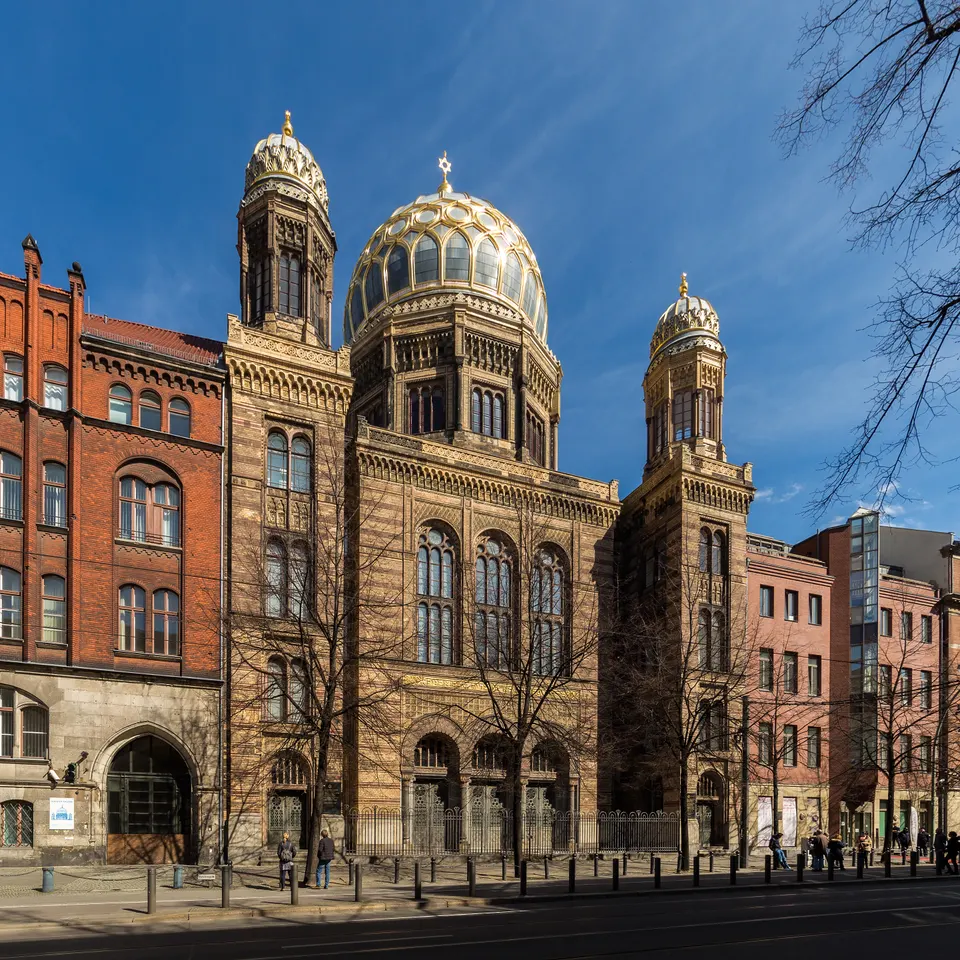
Antisemitism in Europe, 88 years after Kristallnacht: police meet in Berlin and France sets a date for debate
In Berlin, police chiefs met a survivor of the 1938 pogrom. In France, the Senate has put a bill on racism and antisemitism on its December agenda.
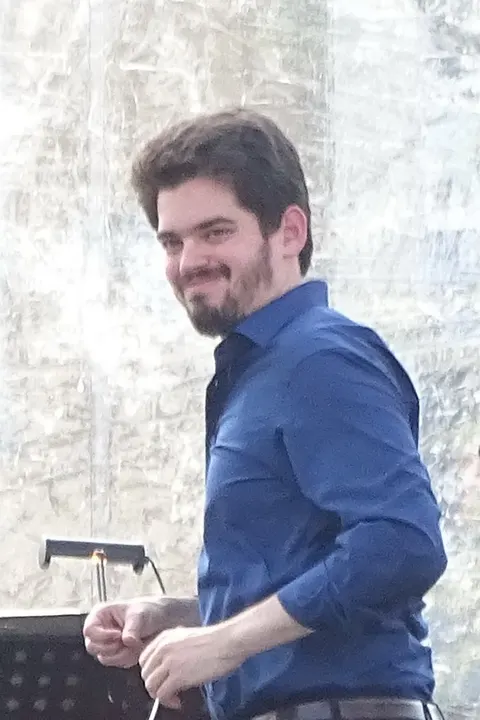
Lahav Shani, from Ghent to Brussels: when must an artist answer for his country?
The same Israeli conductor lost a concert in Ghent and kept his place on the programme in Brussels. From books to sport, who decided to boycott, on what grounds and to what effect?
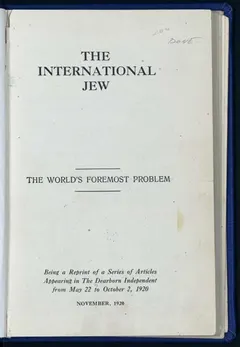
America before the Holocaust: from the lynching of Leo Frank to immigration quotas
From the Leo Frank case to the fate of Jewish refugees, how did antisemitism manifest itself in the United States before the Second World War?