The Protocols of the Elders of Zion: how history’s most widely circulated forgery survived
How were the Protocols of the Elders of Zion exposed as a forgery? The trail leads back to Maurice Joly’s pamphlet and the investigation The Times published in 1921.
Read this article in: FrançaisEspañolItalianoעבריתالعربيةفارسیРусскийहिन्दी
Translated from French. Read the original.

A book a few dozen pages long purports to reproduce the minutes of secret meetings at which the “Elders of Zion” plan to take over the world. The meetings never took place, the elders never existed, and the text was pieced together from passages stolen from a French pamphlet published in 1864 that never mentions Jews 13. All this has been demonstrable since 1921. Yet the Nazi Party reprinted the Protocols of the Elders of Zion, Egyptian television adapted them as a drama, Hamas cited them in its founding charter and, in January 2022, several major online booksellers still listed them 121214. This is the story of how the most widely circulated antisemitic forgery in modern history was made, exposed and kept alive.
St Petersburg, 1903: the first publication
The first known publication of the Protocols dates to 1903. They appeared in instalments that August and September in Znamya (“The Banner”), a St Petersburg newspaper owned by Pavel Krushevan 12. Krushevan was a notorious antisemitic activist. In April that year, articles in another of his newspapers had helped spark the Kishinev pogrom, in which more than 40 people died 12. Some historians believe he may have written the Protocols, alone or with others 1.
A different version was to travel around the world. In 1905, Sergei Nilus, a Russian Orthodox mystical writer, appended the Protocols to his book The Great in the Small: The Coming of the Antichrist and the Rule of Satan on Earth. Nilus portrayed Jews as the agents of satanic forces seeking to destroy the world 12. His text went through several editions and was translated into dozens of languages 14.
In a series of “protocols”, an anonymous speaker describes a small secret group manipulating the press, finance, political parties, wars and revolutions to establish a world government. It gives no names, dates or places. It offers assertions without evidence.
Plagiarism from Maurice Joly (1864) and Hermann Goedsche (1868)
The decisive evidence was published in London. On 16, 17 and 18 August 1921, The Times ran three articles by its Constantinople correspondent Philip Graves, later collected in a pamphlet entitled The Truth about “The Protocols”: A Literary Forgery 3. In Constantinople, Graves had obtained a copy of Dialogue in Hell Between Machiavelli and Montesquieu, a pamphlet published in 1864 by the lawyer Maurice Joly attacking Napoleon III’s regime 34. By printing the texts side by side, Graves showed that entire passages in the Protocols had been copied verbatim, or with only slight changes, from speeches Joly had put in Machiavelli’s mouth. Where Joly described France and Napoleon III, the forger substituted “the world” and “the Jews” 4. The Dialogue does not say a word about Jews 12. The Times called the Protocols a “clumsy forgery” 2. Joly himself had paid for his pamphlet with two years in prison 4.
A year earlier, in 1920, British journalist Lucien Wolf had identified a second source: a chapter of Biarritz (1868), a novel by Hermann Goedsche, a German former postal employee and Prussian police informant 12. The Protocols thus borrowed their structure and wording from Joly and ideas from Goedsche 12.
Who assembled the text? The historians’ accounts
Knowing that the text was plagiarised tells us neither who assembled it nor when. Two accounts compete.
The first, now familiar, attributes the forgery to the Okhrana, the tsar’s political police, and its Paris branch under Pyotr Rachkovsky. In November 1999, Russian historian Mikhail Lepekhine announced in L’Express that he had identified the forger from Soviet archives. He said Matvei Golovinski (1865–1920), a journalist working for Rachkovsky in Paris, had written it “in late 1900 or in 1901” to persuade the tsar that modernising Russia was a Jewish plot 45. Golovinski had already been named at the Bern trial in 1934 and, much earlier, by Princess Catherine Radziwill, whose testimony is considered erroneous and unsupported 4.
The second account challenges the Paris connection. Historian Michael Hagemeister considers the evidence for attributing the forgery to Rachkovsky and Golovinski insufficient 6. On the evidence of the earliest Russian editions, philologist Cesare De Michelis argues that it was written in Russia 67.
No reputable historian disputes that the text is a forgery, plagiarised and produced in antisemitic circles in the Russian Empire around the turn of the century.
Henry Ford and the White Russians: the text spreads worldwide, 1919–1922
During the Russian Civil War (1918–1921), the White armies printed the Protocols while pogroms killed tens of thousands, particularly in Ukraine 2. Émigrés carried the text to Europe. The first foreign edition appeared in Germany in 1919, followed in 1920 by editions in France, England, the United States and Japan. This time the book was presented as an explanation of the Bolshevik Revolution 12. The Nazi Party bought the rights to the German edition in 1929 211.
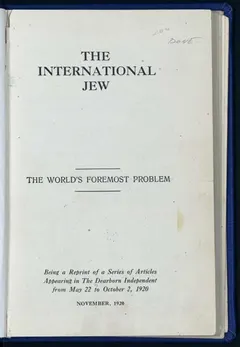
In the United States, car manufacturer Henry Ford was its chief promoter. On 22 May 1920, his weekly The Dearborn Independent began a series entitled “The International Jew: The World’s Problem”, which ran to 91 articles. On 24 July it published “An Introduction to the Jewish Protocols” 28. Collected as The International Jew, the articles sold more than 500,000 copies and were translated into at least 16 languages. By 1922 the German edition was in its 21st printing 18. Sued for libel by lawyer Aaron Sapiro, Ford published an apology in the press on 8 July 1927 and closed his paper, but foreign publishers ignored his request to withdraw the book 28. In 1938, Hitler had him presented with the Grand Cross of the German Eagle 8. Our feature on American antisemitism before the Holocaust revisits this episode.
Under the Nazis: from Mein Kampf to the classroom
In Germany the text passed from Russian émigré circles into the National Socialist movement. Party ideologue Alfred Rosenberg published a commentary in 1923, The Protocols of the Elders of Zion and Jewish World Politics, which brought the text to Hitler’s attention 2. In Mein Kampf in 1925, Hitler wrote that the Protocols revealed “the nature and activity” of the Jewish people and exposed “their ultimate aims” 12.
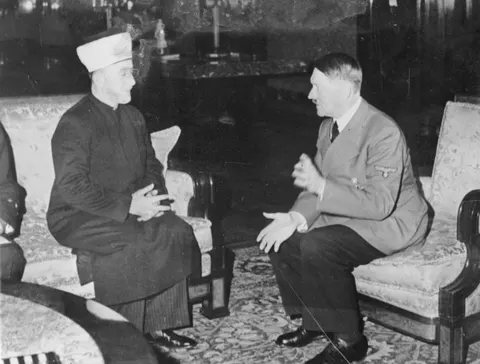
After the Nazis took power in 1933, use of the text became official. Julius Streicher’s newspaper, Der Stürmer, made it the subject of front-page articles 2. In November 1934, Education Minister Bernhard Rust added Rosenberg’s book on the Protocols to the book list for German public schools 9. The 22nd German printing appeared in 1938. The Nazi Party’s publisher had acquired the rights in 1929. The preface to the 1938 printing used the forgery to justify the Nuremberg Laws 211. In 1943, when millions of Jews had already been murdered, German authorities were still publishing the Protocols in Russian, Ukrainian and Belarusian, as well as in occupied France, Belgium and Poland. That year Amin al-Husseini, the Mufti of Jerusalem, repeated their themes in his Arabic broadcasts on Radio Berlin 2 (see our feature on the Mufti’s meeting with Hitler).
The Bern trial, 1933–1937: what the court ruled
In June 1933, copies of the Protocols were distributed in Bern at a rally of the National Front, a Swiss far-right party. Swiss Jewish organisations filed a complaint under a Bernese law against “trash literature” (Schundliteratur). Witnesses came from the Russian émigré community and Nazi Germany financed the defence 110.
On 14 May 1935, Judge Walter Meyer ruled that the Protocols were a forgery, constituted plagiarism and fell under the heading of trash literature. He fined two defendants, Theodor Fischer and Silvio Schnell, 50 and 20 francs respectively. Three others were acquitted 910. “I am imposing a light sentence because I do not want to create martyrs,” he explained. He hoped “the time will come when no one will understand why the Protocols could ever have been taken seriously” 9.
The defence appealed. On 1 November 1937, the Bern cantonal court of appeal (Obergericht) acquitted the two men 1011. Nazi propaganda presented that judgment as vindicating the text, making it important to understand the scope of the ruling 11. The sole question on appeal was whether the Protocols fell within the legal category of Schundliteratur. The court held that they did not 10. It did not re-examine authenticity or contradict the 1935 finding that the text was a forgery. Its ruling concerned the criminal classification 10. Michael Hagemeister, who wrote a book on the trial, notes that the Okhrana account became “canonical” through the proceedings, although it rested on Russian émigré testimony he considers to have no evidentiary value 6.
After 1945: the Middle East, the Hamas charter and television
The defeat of Nazism did not end circulation of the text. An early Arabic translation was already circulating in Damascus in 1925 12. After 1948, the Protocols became an instrument of anti-Israel propaganda. An edition appeared in Karachi in 1969. King Faisal of Saudi Arabia gave copies to official visitors in the early 1970s. An English edition appeared in Iran in 1985 12.
Hamas published its founding charter on 18 August 1988. Article 32 alleges that after Palestine “world Zionism” intends to expand “from the Nile to the Euphrates” and then beyond. It concludes: “Their plan is embodied in the ‘Protocols of the Elders of Zion’, and their present conduct is the best proof of what we are saying” 12. Article 22 follows the forgery’s reasoning, alleging that “with their money, they took control of the world media, news agencies, the press and publishing houses”, and blaming Jews for the French Revolution, the communist revolution and both world wars 12. In 2017 Hamas published a new Document of General Principles and Policies 12.
During Ramadan in November 2002, the Egyptian private channel Dream TV, followed by state television, broadcast Horseman Without a Horse, a 41-part drama co-written by and starring Mohamed Sobhi. Its hero discovers the Protocols and concludes that his real enemy is the Zionists rather than the British occupiers 213. On 20 November 2002, the US Senate adopted Resolution 366 by unanimous consent. Among other measures, it called on Egypt to prevent state channels from broadcasting programmes legitimising the Protocols 16. Cairo maintained that the series was not antisemitic. Sobhi said that to Americans and Israelis a programme made by him was equivalent to “a nuclear weapon” 213. In 2005, a Syrian edition authorised by the Information Ministry blamed the Elders of Zion for the attacks of 11 September 2001 12.
Online sales documented in 2022
Now in the public domain, the text is only a few clicks away. In January 2022 the Jerusalem Post reported that Barnes & Noble, Walmart, Book Depository, Thrift Books and Hudson Books sold “dozens of versions”. The Barnes & Noble listing suggested that “if the text is authentic”, it invited readers to keep watch on world affairs 14. In Britain, Blackwell’s offered the book with a description saying it “neither endorses nor denies its message”. After hundreds of protests on social media, Blackwell’s removed it on 26 January 2022, explaining that the description had come from an automated publisher feed. Barnes & Noble followed in the ensuing days 14. A Russian court ruled in 1993 that the text was a forgery and publishing it was antisemitic. Yet in 2024 a US State Department report found that the Protocols retained “significant influence” in Russia 2. The United States Holocaust Memorial Museum in Washington, which devoted an exhibition to the text from 2006 to 2018 (“A Dangerous Lie”), notes that it now circulates “in print, on television, on the internet and on social media” 12.
In France, Pierre-André Taguieff devoted three studies to the Protocols (1992, 2004, 2024). He focused less on the text’s origins than on its reception: why people believe it and what they do with it 15. Before him, in Warrant for Genocide, Norman Cohn described the myth of a worldwide Jewish conspiracy as one of the intellectual forces behind the Holocaust 15.
Chronology
- 1864 — Maurice Joly publishes Dialogue in Hell Between Machiavelli and Montesquieu, a pamphlet against Napoleon III. He is sentenced to two years in prison 4.
- 1868 — Hermann Goedsche publishes Biarritz. One chapter portrays a secret Jewish gathering in the Prague cemetery 12.
- April 1903 — Krushevan’s newspapers help fuel the Kishinev pogrom 12.
- August-September 1903 — The Protocols first appear in instalments in St Petersburg’s Znamya 12.
- 1905 — Sergei Nilus appends the Protocols to The Great in the Small 12.
- 1919 — The first foreign-language edition appears in Germany. The Nazi Party acquires the rights in 1929 2.
- 22 May 1920 — Henry Ford’s Dearborn Independent begins its “International Jew” series 8.
- 16-18 August 1921 — The Times publishes Philip Graves’s three articles showing how the forger plagiarised Joly 3.
- 1925 — Hitler cites the Protocols in Mein Kampf. The first Arabic translation appears in Damascus 12.
- November 1934 — Minister Rust adds Rosenberg’s commentary to the book list for German schools 9.
- 14 May 1935 — The Bern court finds the Protocols a forgery, plagiarism and trash literature 910.
- 1 November 1937 — The Bern appeals court acquits on the legal classification alone, leaving the finding of forgery intact 1011.
- 1943 — German editions appear in Russian, Ukrainian and Belarusian. The Mufti broadcasts on Radio Berlin 2.
- 18 August 1988 — Hamas issues its charter, citing the Protocols in Article 32 12.
- November 2002 — Egyptian television broadcasts the 41-part Horseman Without a Horse 213.
- 26 January 2022 — Blackwell’s and then Barnes & Noble remove the book from their websites after protests 14.
What this tells us
Nazi propaganda, the 1988 Hamas charter and certain allegations made during the pandemic recycled the forgery 121112. The versions vary, but the passages the forgers copied from Maurice Joly have been identifiable since The Times printed the comparison in 1921 3.
Sources
- United States Holocaust Memorial Museum, « Protocols of the Elders of Zion », Holocaust Encyclopedia, mis à jour 2026, https://encyclopedia.ushmm.org/content/en/article/protocols-of-the-elders-of-zion ; panneau de l'exposition « A Dangerous Lie » (2006-2018), https://encyclopedia.ushmm.org/content/en/photo/a-dangerous-lie-the-protocols-of-the-elders-of-zion-exhibition
- United States Holocaust Memorial Museum, « Protocols of the Elders of Zion: Key Dates », Holocaust Encyclopedia, 19 novembre 2024, https://encyclopedia.ushmm.org/narrative/10552/en
- The Times (Londres), The Truth about « The Protocols »: A Literary Forgery (réimpression des articles des 16, 17 et 18 août 1921), Londres, 1921, Internet Archive, https://archive.org/details/truthaboutthepro00londiala ; page du 17 août 1921 reproduite par l'USHMM, https://encyclopedia.ushmm.org/content/en/artifact/the-times-august-17-1921
- Éric Conan, « Les secrets d'une manipulation antisémite », L'Express, 16 novembre 1999, reproduit sur PHDN, http://www.phdn.org/antisem/protocoles/origines.html
- Jewish Telegraphic Agency, « Author of anti-Semitic "Protocols" identified », 23 novembre 1999, https://www.jta.org/1999/11/23/lifestyle/author-of-anti-semitic-protocols-identified
- Michael Hagemeister, « The Protocols of the Elders of Zion in court: the Bern trials, 1933-1937 », dans The Global Impact of the Protocols of the Elders of Zion, Routledge, 2011, https://www.taylorfrancis.com/chapters/edit/10.4324/9780203814291-25/protocols-elders-zion-court-bern-trials-1933%E2%88%921937-michael-hagemeister ; compte rendu de sa conférence de Cambridge du 4 novembre 2014, https://www.cambridgeclarion.org/journal/hagemeister_protocols_4nov2014.html
- Cesare G. De Michelis, The Non-Existent Manuscript: A Study of the Protocols of the Sages of Zion, University of Nebraska Press, 2004 (éd. originale italienne 1998), notice Open Library, https://openlibrary.org/isbn/9780803217270
- United States Holocaust Memorial Museum, « Antisemitism and Henry Ford's "International Jew" », Holocaust Encyclopedia, https://encyclopedia.ushmm.org/content/en/article/antisemitism-and-henry-fords-international-jew
- Jewish Telegraphic Agency, « Reich Officials Put Protocols on School List », 11 novembre 1934, https://www.jta.org/archive/reich-officials-put-protocols-on-school-list ; « Brand "Protocols" False », 15 mai 1935, https://www.jta.org/archive/brand-protocols-false ; « "Protocols" False, Court Rules, Blasting 30-year-old Myth », 15 mai 1935, https://www.jta.org/archive/protocols-false-court-rules-blasting-30-year-old-myth
- Wiener Library (Université de Tel-Aviv), collection Hadassa Ben-Itto, « Acquittal in the Bernese Zionist trial II – no trash literature according to law » (coupures de presse, novembre-décembre 1937), portail EHRI, https://portal.ehri-project.eu/units/il-002820-9932929395004146-9932984996604146 ; « 90 Years Since the Berne Trials », https://en-cenlib.tau.ac.il/node/2206
- German Propaganda Archive (Calvin University), introduction de la 22e édition nazie des Protocoles (Die Geheimnisse der Weisen von Zion, Eher Verlag, 1938), traduction et note de Randall Bytwerk, https://research.calvin.edu/german-propaganda-archive/protocols.htm
- Avalon Project (Yale Law School), « Hamas Covenant 1988: The Covenant of the Islamic Resistance Movement », 18 août 1988, https://avalon.law.yale.edu/21st_century/hamas.asp ; extraits et note sur le document de 2017, Federation of American Scientists, https://irp.fas.org/world/para/docs/880818a.htm
- Sarah Gauch, « Egyptian TV "Knight" crusades against US, Jews », The Christian Science Monitor, 22 novembre 2002, https://www.csmonitor.com/2002/1122/p07s02-wogi.html ; Voice of America, éditorial « Egyptian Television Series », 23 novembre 2002, https://editorials.voa.gov/a/a-41-a-2002-11-23-3-1-83035762/1477652.html
- Michael Starr, « "Elders of Zion" book being sold by top booksellers », The Jerusalem Post, 26 janvier 2022, https://www.jpost.com/diaspora/antisemitism/article-694559 ; Jewish News, « UK bookstore removes Protocols from sale after outcry from Jewish leaders », 26 janvier 2022, https://www.jewishnews.co.uk/uk-bookstore-removes-protocols-from-sale-after-outcry-from-jewish-leaders/ ; JTA/Forward, « Barnes & Noble removes "The Protocols of the Elders of Zion" from its site », janvier 2022, https://forward.com/fast-forward/481606/barnes-amp-noble-removes-the-protocols-of-the-elders-of-zion-from-its-site/
- Pierre-André Taguieff, Les Protocoles des sages de Sion, des origines à nos jours, entretien avec Roman Bornstein, Hermann, 2024, notice BnF, https://catalogue.bnf.fr/ark:/12148/cb474234084 ; bibliographie de l'auteur (éditions de 1992 et 2004, Berg International), https://leddv.fr/?p=6853 ; Norman Cohn, Warrant for Genocide, rééd. Serif, notice Publishers Weekly, https://www.publishersweekly.com/978-1-897959-25-1
- Sénat des États-Unis, résolution 366, Congressional Record du 20 novembre 2002, p. S11790–11791, https://www.govinfo.gov/content/pkg/CREC-2002-11-20/pdf/CREC-2002-11-20-pt2-PgS11790-2.pdf
The story in 30 seconds
Read the main facts at a glance and share the link.
- Pavel Krushevan’s Znamya serialised the Protocols in St Petersburg in August–September 1903. In 1905 Sergei Nilus appended them to a book on the Antichrist.
- 16–18 Aug 1921:, The Times traced it to Joly’s 1864 satire of Napoleon III, which never mentions Jews. On 14 May 1935 a Bern court found forgery and plagiarism.
- Henry Ford promoted the forgery in the US from 1920. A Nazi publisher issued a 22nd German printing in 1938. The 1988 Hamas charter cited it.
Spotted an error or a missing source? Write to us : we publish corrections in the article.
Related reading
America before the Holocaust: from the lynching of Leo Frank to immigration quotas
From the Leo Frank case to the fate of Jewish refugees, how did antisemitism manifest itself in the United States before the Second World War?

Dan Bilzerian says he is criticising Israel. In 2011, he was already blaming Jews for 9/11
From poker to a Florida primary, what Dan Bilzerian has said about Jews and the Holocaust, as documented in broadcasts and archival material.
The Mufti of Jerusalem meets Hitler: what the documents say
On 28 November 1941, Hitler received the Mufti of Jerusalem in Berlin. What does the German record establish about their meeting and its consequences?