The departure of Jewish communities from Arab countries and Iran in the 20th century
From Iraq to Morocco and Iran, violence, changes to nationality laws and organised migration transformed Jewish communities in the course of the 20th century.
Read this article in: FrançaisEspañolItalianoעבריתالعربيةفارسیРусскийहिन्दी
Translated from French. Read the original.

On 24 September 1950, two planes landed at Lod carrying 177 passengers. They were the last of some 380 flights that had brought nearly 50,000 Jews from Yemen to Israel since June 1949 8. Operation On Wings of Eagles, nicknamed Magic Carpet, was one episode in a much larger movement. Within a generation, the Jewish communities of the Arab world, some 2,500 years old, had all but disappeared. The Jewish Virtual Library’s table gives a total of about 851,000 people in 1948 and fewer than 4,000 in 2023 for the Arab countries it covers 14. Including Iran brings the initial figure close to a million 13. We trace that history country by country, then turn to the reception in Israel, the fate of property and the belated recognition of the exodus.
Iraq: from the Farhud of 1941 to the hangings of 1969
Iraq had some 135,000 Jews, nearly 3% of its population. About 90,000 lived in Baghdad 1. On 2 April 1941, Rashid Ali al-Gaylani took power in a pro-German coup backed by Haj Amin al-Husseini, the Mufti of Jerusalem (see our feature on the Mufti). The British retook the country in May. On 1 June 1941, the festival of Shavuot, as the regent returned to Baghdad, Iraqi soldiers and police officers, members of the pro-Axis Futuwwa youth movement and civilians attacked the city’s Jews. The massacre, known as the Farhud (“violent dispossession”), lasted two days. The United States Holocaust Memorial Museum (USHMM) gives a toll of 150 to 180 dead and 600 injured. The Iraqi commission of inquiry had counted 128 dead. More than 1,500 homes and businesses were looted 1. Other counts put the death toll at 179 21.
The break came after 1948. In March 1950, Iraq’s parliament allowed Jews alone to leave the country on condition that they renounce their nationality and any right of return. The law was valid for one year. Baghdad had expected 6,000 or 7,000 departures. About 125,000 people registered 2. On 10 March 1951, the day after that law expired, a second law placed “the property of Jews who have lost Iraqi nationality” under state administration 2. Operation Ezra and Nehemiah, the airlift to Israel, ended in early 1952. By the end of 1951, about 124,000 of Iraq’s 135,000 Jews had emigrated to Israel 1. Some 10,000 remained 2.
For those who stayed, the worst came after the Baath Party seized power in 1968. On 27 January 1969 in Baghdad, a revolutionary court had 14 people accused of spying for Israel hanged: nine Jews, two Christians and three Muslims 3. The hangings were public 21. A US State Department intelligence memorandum dated 14 February 1969 described the Jewish defendants as “credible scapegoats” for a regime in trouble and noted that a community once numbering over 100,000 had dwindled to about 3,000 3. Five Jews remained in Iraq in 2025 13.
Egypt in 1948, 1956 and 1967
Egypt had 75,000 Jews in 1948 414. Between June and November that year, during the war with Israel, bombings in Cairo’s Jewish quarter killed over 70 people and wounded nearly 200 4. The Suez crisis marked the turning point. In November 1956, following the French, British and Israeli attack, Nasser’s government expelled nearly 25,000 Jews and confiscated their property. About 1,000 others were sent to prison or camps. A proclamation on 23 November 1956 described all Jews as “Zionists and enemies of the state”. Those leaving could take one suitcase and a small sum of money and had to sign a document “donating” their property to the government 4. At the outbreak of the Six-Day War in June 1967, Jewish property was again confiscated 4 and Jewish men were interned, about 400 according to a family account published by the Hudson Institute. The last were released in 1970 5. Fewer than ten Jews remained in Egypt in 2020 4.
Libya: Tripoli in 1945, 1948 and 1967
Libya had 38,000 Jews in 1948 714. From 5 to 7 November 1945, under British military administration, a three-day pogrom struck Tripoli and the surrounding area. The Yad Vashem resource centre records 121 Jews murdered 6. Other counts exceed 140 7. Synagogues were destroyed and hundreds of homes and businesses ransacked 6. Fresh rioting in Tripoli on 12 June 1948 left 12 people dead and 280 Jewish homes destroyed 7. After Israel’s founding, over 30,000 Jews left Libya for the new state 6. The roughly 7,000 who remained came under attack in June 1967. Eighteen were killed, and almost everyone left 7. After Muammar Gaddafi’s coup in 1969, all Jewish property was confiscated and debts owed to Jews were cancelled 7. The confiscation is dated to 1970 21. Libya’s last Jewish woman, Esmeralda Meghnagi, died in February 2002 7.
Yemen: Operation Magic Carpet
In 1948, 55,000 Jews lived in Yemen and a further 8,000 in Aden, then a British colony 13. Riots broke out in Aden in December 1947 after the UN vote on partition 21. Between June 1949 and 24 September 1950, nearly 50,000 Yemeni Jews flew to Israel from Aden. Many had walked for weeks to get there 8. One Jew remained in Yemen in 2025 13.
Syria: Aleppo in 1947 and a border closed until 1992
Syria had 30,000 Jews in 1948 1314. After the partition vote in 1947, crowds attacked the Jewish community in Aleppo. Dozens died and over 200 homes, businesses and synagogues were destroyed 9. From 1947, emigration was forbidden on pain of death or forced labour. Jews were barred from government service and banking, and their accounts were frozen. On the rare occasions travel was permitted, a bond was required and relatives had to stay behind as hostages 9. In 1974, 4,000 to 5,000 Jews still lived in Syria 9. Only in 1992 did Hafez al-Assad formally allow them to leave. Thousands went, mainly to Brooklyn. In 1994, a discreet operation brought 1,262 to Israel. According to the same source, about 250 remained in Damascus in 1995 9. For 2025, the Jewish Virtual Library gives a figure of six for Syria and JJAC counts three 913.
The Maghreb: three different paths
French North Africa accounted for more than half the total in 1948, with 265,000 Jews in Morocco, 140,000 in Algeria and 105,000 in Tunisia 1314. Many of those leaving Algeria in 1962 went to France 11. In Morocco, Operation Yakhin organised some of the departures 10.
Riots in Jerada and Oujda in Morocco in June 1948 left dozens dead 21. More than 120,000 Jews left for Israel between 1948 and 1961 10. After independence in 1956, emigration to Israel was restricted, then resumed in a different form. Operation Yakhin, negotiated with Rabat, ran from 28 November 1961 to 1964. Israel paid $500,000, then $100 per emigrant for the first 50,000 and $250 thereafter. The American organisation HIAS provided $50 million for the operation. More than 97,000 Jews left Morocco via France or Italy, some settling in France, Canada or the United States 10. About 2,500 remained in 2025 13. Over the last two decades, the kingdom has distinguished itself by preserving its Jewish heritage 21.
In Algeria, the Crémieux Decree of 24 October 1870 had made Jews French citizens 1121. At independence in 1962 they left with other French Algerians. Nearly 130,000 went to France, compared with 25,681 who had gone to Israel since 1948 11. Tunisia’s Jewish population fell from 105,000 in 1948 to 10,000 in 1968 and 1,500 today 13. Departures for France and Israel accelerated after the riots of June 1967 21.
Iran: the 1979 revolution
Iran is not an Arab country, but its history intersects with that of its neighbours. Before 1948, its Jewish community numbered about 80,000 21, or as many as 100,000 by other estimates 13. The Islamic Revolution of 1979 changed everything. Habib Elghanian, born in Tehran in 1912, founded Plasco, the Middle East’s first plastics manufacturer, and had headed the Jewish community since 1959. After a 20-minute trial, he was shot on 9 May 1979 for “Zionist espionage” and “corruption on earth”. His execution hastened departures 12. The 2025 column in JJAC’s table gives an estimate of 8,756 for Iran 13.
Reception in Israel: the maabarot
Israel had 650,000 Jews at its founding in May 1948. More than 800,000 immigrants arrived in the next decade 15. To house them, the Jewish Agency began opening transit camps, the maabarot, in 1950. By the end of that year, 62 camps housed 93,000 people. At the end of 1951 the camps held 220,517, or 256,506 counting all forms of temporary housing. Families lived in huts measuring 10 to 15 square metres, with no water or electricity. Two-thirds of residents came from Muslim countries. At the end of 1963, 15,300 people still lived in the camps 15. About 70% of Jews leaving Arab countries settled in Israel, the rest in France, Britain, the United States or Canada 13. In a survey published by Pew in 2016, Jewish Israeli respondents were roughly evenly divided between those who identified as Ashkenazi and those who identified as Sephardi or Mizrahi 16.
Property left behind: estimates vary
What were the homes, businesses, land and bank accounts worth? Justice for Jews from Arab Countries (JJAC) puts the figure at $263 billion in today’s money 13. In January 2019, the Jerusalem Post reported an estimate of $250 billion in connection with possible compensation claims 18. American historian Michael Fischbach, author of a 2008 academic study of the claims, is more cautious. Reliable figures are hard to establish. The sums Israel documented in the 1950s were small compared with Palestinian claims, and no legal action has produced substantial compensation 17.
Belated recognition
Security Council Resolution 242, adopted on 22 November 1967, affirmed the need for “a just settlement of the refugee problem” without specifying which refugees 20. Associations representing Jews from Arab countries understand the wording to cover both displaced populations 1321. For Palestinian refugees, the UN had established a dedicated agency, UNRWA, in 1949. The descendants of male Palestine refugees, including adopted children, are eligible to register with UNRWA 23.
In June 2014, on a proposal by lawmakers Shimon Ohayon and Nissim Zeev, the Knesset passed a law designating 30 November, the day after the anniversary of the 1947 partition plan, as a day commemorating the departure and expulsion of Jews from Arab countries and Iran. At the first ceremony on 30 November 2014, President Reuven Rivlin said recognition had come “too late and on too small a scale”. The law’s sponsors regretted the subject’s absence from school curricula. According to Zeev, 650,000 of these Jews came to Israel, with most of the rest going to Europe and America 19.
Chronology
- 1941-06-01 — The Farhud in Baghdad lasts two days and kills 150 to 180 people, according to the USHMM 1.
- 1945-11-05 — The three-day Tripoli pogrom kills 121 people, according to Yad Vashem 6.
- 1947-11-29 — UN partition plan. Riots follow in Aleppo and Aden in the ensuing weeks 921.
- 1948-06-07 — Riots in Jerada and Oujda, Morocco. In Tripoli, 12 people are killed on 12 June 721.
- 1949-06 — The Magic Carpet airlift from Aden to Israel begins. By its end on 24 September 1950, it has carried nearly 50,000 people 8.
- 1950-03 — Iraq permits Jews to leave if they renounce their nationality. About 125,000 register. On 10 March 1951, the state takes control of their property 2.
- 1951-12 — In Israel, 220,517 people live in the maabarot 15.
- 1956-11-23 — An Egyptian proclamation calls all Jews “Zionists and enemies of the state”. Nearly 25,000 are expelled 4.
- 1961-11-28 — Operation Yakhin begins in Morocco. More than 97,000 leave by 1964 10.
- 1962 — Algeria becomes independent. Nearly 130,000 Jews leave for France 11.
- 1967-06 — Six-Day War. Confiscations and internment in Egypt, and 18 people killed in Libya 457.
- 1967-11-22 — Resolution 242 calls for “a just settlement of the refugee problem” 20.
- 1969-01-27 — Fourteen people, nine of them Jews, are publicly hanged in Baghdad 321.
- 1979-05-09 — Habib Elghanian is executed in Tehran 12.
- 1992 — Hafez al-Assad allows Jews to leave Syria 9.
- 2014-06 — The Knesset designates 30 November a day of commemoration 19.
What this tells us
This history corrects a misleading picture of Israel as a country populated by Europeans who settled in the Middle East. In the survey Pew published in 2016, Jewish Israeli respondents were roughly evenly divided between those who identified as Ashkenazi and those who identified as Sephardi or Mizrahi 16. It also sheds light on the refugee debate. The 1948 war and its aftermath produced two population displacements, that of Palestinian Arabs and that of Jews from Arab countries. The first received a UN agency and decades of attention. The second prompted advocacy by associations, a US resolution in 2008 and a day of remembrance in Israel in 2014 1719. Recognising the second does not erase the first, and historians differ on how the two were related. Finally, measures taken against Jews in the name of opposing Israel, from loss of citizenship and confiscations to internment and public hangings, targeted citizens who for the most part had sought none of this. The shift from anti-Zionism to the persecution of Jews, also at work at the UN in the 1970s (see Resolution 3379), is not confined to the past.
Sources
- United States Holocaust Memorial Museum, « Le Farhoud », Encyclopédie multimédia de la Shoah, https://encyclopedia.ushmm.org/content/fr/article/the-farhud
- JNS, « 75 years ago, Iraq stripped its Jews of citizenship », Jewish News Syndicate, 6 mars 2025, https://www.jns.org/75-years-ago-iraq-stripped-its-jews-of-citizenship/
- Département d'État des États-Unis, Office of the Historian, Foreign Relations of the United States, 1969-1976, vol. E-4, document 251, Research Memorandum RNA-6 « Iraq: Internal Stresses and the Search for the Bogeyman », 14 février 1969, https://history.state.gov/historicaldocuments/frus1969-76ve04/d251
- Jewish Virtual Library (AICE), « The Jews of Egypt », https://www.jewishvirtuallibrary.org/jews-of-egypt
- Lela Gilbert, « Remembering Their Flight from Egypt », Hudson Institute (paru dans The Jerusalem Post), 30 novembre 2009, https://www.hudson.org/human-rights/remembering-their-flight-from-egypt
- Yad Vashem, Shoah Resource Center, « Libya », https://wwv.yadvashem.org/odot_pdf/Microsoft%20Word%20-%206407.pdf
- Jewish Virtual Library (AICE), « The Jews of Libya », https://www.jewishvirtuallibrary.org/jews-of-libya
- The Jerusalem Post, « On this day: The conclusion of Operation Magic Carpet », 24 septembre 2021, https://www.jpost.com/israel-news/on-this-day-the-conclusion-of-operation-magic-carpet-680199
- Jewish Virtual Library (AICE), « The Jews of Syria », https://www.jewishvirtuallibrary.org/jews-of-syria
- Center for Israel Education, « Operation Yachin Begins Bringing Jews from Morocco », https://israeled.org/operation-yachin-begins-bringing-jews-from-morocco
- Jewish Virtual Library (AICE), « The Jews of Algeria », https://www.jewishvirtuallibrary.org/jews-of-algeria
- Center for Israel Education, « Iranian Jewish Leader Habib Elghanian Executed », https://israeled.org/iranian-jewish-leader-habib-elghanian-executed
- Justice for Jews from Arab Countries (JJAC), « Facts & Figures » (tableau des populations juives 1948-2025, biens, résolution 242), https://justiceforjews.com/facts-figures/
- Jewish Virtual Library (AICE), « Jewish Population of the Arab World », d'après Sergio DellaPergola, « World Jewish Population, 2021 », American Jewish Year Book 2023, Springer, 2024, https://www.jewishvirtuallibrary.org/jewish-populations-in-the-arab-world
- Jonathan Kaplan (Agence juive pour Israël), « Absorbing the Exiles », My Jewish Learning, https://www.myjewishlearning.com/article/absorbing-the-exiles/
- Pew Research Center, « Israel's Religiously Divided Society », 8 mars 2016, https://www.pewresearch.org/religion/2016/03/08/israels-religiously-divided-society/
- Michael R. Fischbach, « The Hidden Agenda Behind the Jewish Refugees Resolution », History News Network, 27 juillet 2008, https://www.historynewsnetwork.org/article/52679
- Tamar Uriel-Beeri, « Israel to seek $250bil in compensation from Arab, Muslim countries », The Jerusalem Post, 5 janvier 2019, https://www.jpost.com/breaking-news/estimate-of-lost-jewish-property-value-in-tunisia-libya-50-billion-576427
- The Jerusalem Post (reproduit par l'Institute for Jewish Ideas and Ideals), « Israel Recognizes the Travails of Jews from Arab Lands and Iran », 30 novembre 2014, https://www.jewishideas.org/article/israel-recognizes-travails-jews-arab-lands-and-iran
- Conseil de sécurité des Nations unies, résolution 242 (1967), 22 novembre 1967, texte reproduit par Michael Zank, Boston University, https://www.bu.edu/mzank/Jerusalem/tx/UN242.htm
- David Bensoussan, « L'Exode oublié des Juifs des pays arabo-musulmans », mémoire présenté au Comité permanent des affaires étrangères et du développement international du Parlement du Canada, 2 mai 2013 (PDF hébergé par le CRIF), https://www.crif.org/sites/default/fichiers/images/documents/nl2%20L%27Exode%20oubli%C3%A9%20des%20Juifs%20des%20pays%20arabo-musulmans.pdf
- Olivier Stirn, recension de Georges Bensoussan, Juifs en pays arabes. Le grand déracinement, 1850-1975 (Tallandier, 2012), Académie des sciences d'outre-mer, 2013, https://www.academieoutremer.fr/images/files/Juifs-Pays-Arabes-%2858_402%29.pdf
- UNRWA, Palestine Refugees, critères d’inscription, https://www.unrwa.org/palestine-refugees
The story in 30 seconds
Read the main facts at a glance and share the link.
- In 1948, about 850,000 Jews lived in the Arab countries covered by the figures in this article. Iran is counted separately.
- An Iraqi law passed in 1950 allowed Jews to give up their citizenship to leave. In Morocco, Operation Yakhin organised departures from 1961 to 1964.
- In June 2014, the Knesset set aside 30 November to commemorate the departure and expulsion of Jews from Arab countries and Iran.
Spotted an error or a missing source? Write to us : we publish corrections in the article.
Related reading
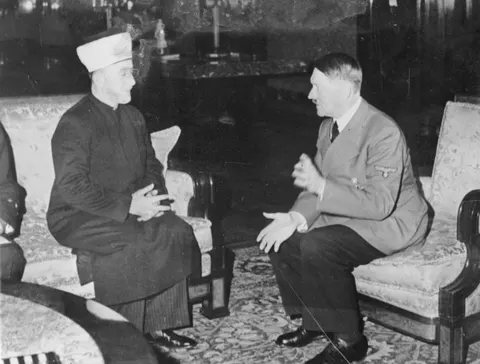
The Mufti of Jerusalem meets Hitler: what the documents say
On 28 November 1941, Hitler received the Mufti of Jerusalem in Berlin. What does the German record establish about their meeting and its consequences?
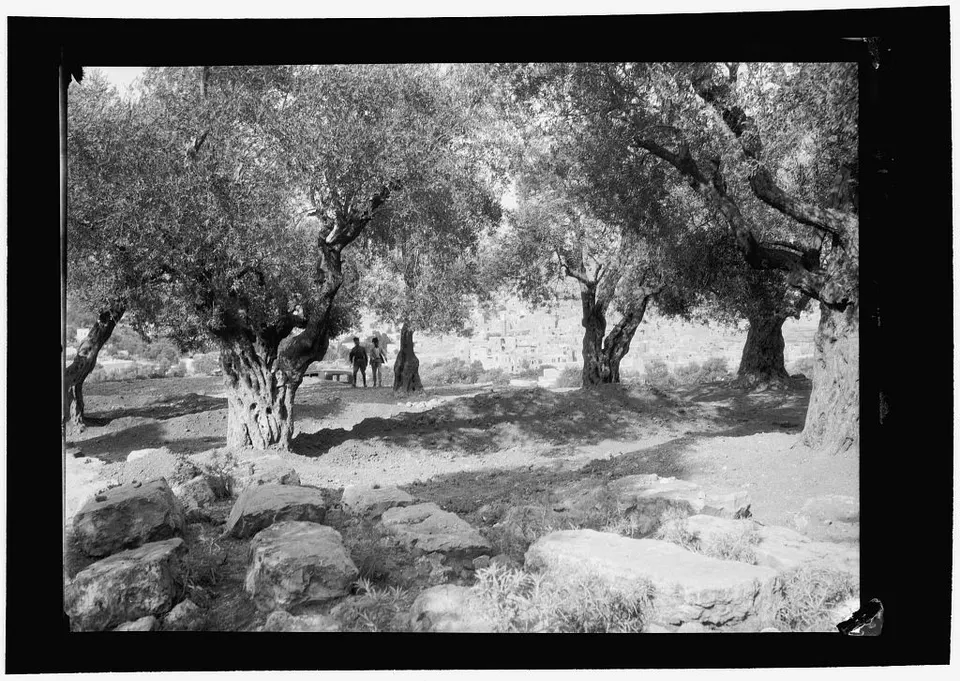
Hebron, 24 August 1929: the massacre that uprooted a four-century-old Jewish community
What happened in Hebron in August 1929? This account traces the massacre of Jewish residents, the help given by Arab neighbours and the evacuation of the survivors.
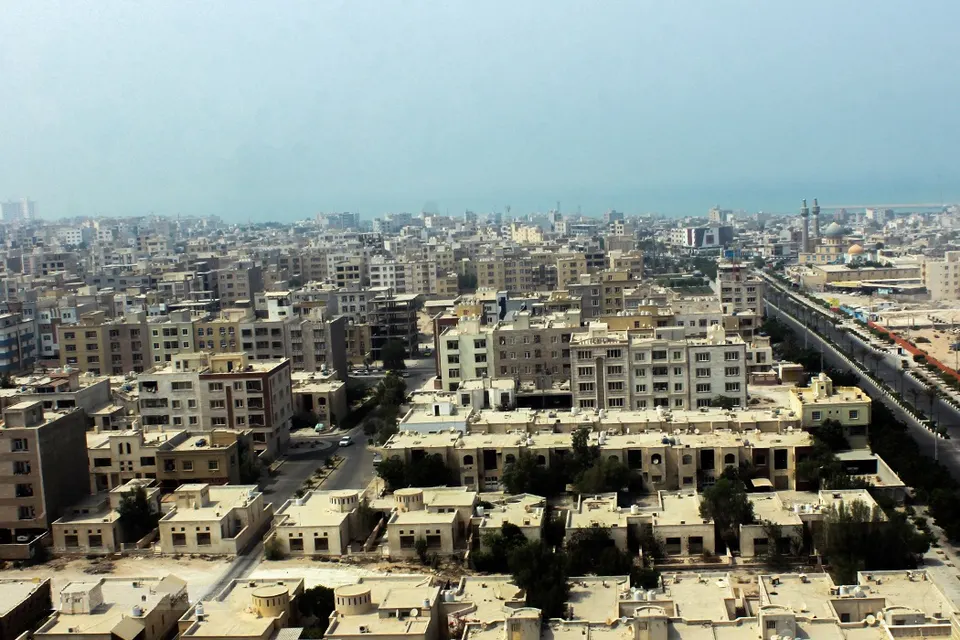
Iran and Lebanon: strikes on Qeshm as Qatar mediates between Washington and Tehran
Strikes continued in Iran and Lebanon from 2 to 9 November 2026. Qatar is trying to bring Washington and Tehran closer together on the nuclear issue.