The “Ryazan sugar”: the night in September 1999 when Russians began to doubt the FSB
How does the Ryazan incident fit into the Russian apartment bombings of 1999? Witness testimony and the FSB’s account help explain what remains disputed.
Read this article in: FrançaisEspañolItalianoעבריתالعربيةفارسیРусскийहिन्दी
Translated from French. Read the original.

In September 1999, four apartment bombings killed about 300 people in Russia 111213. On 22 September, a Ryazan resident reported suspicious sacks in his basement. Police suspected an attempted bombing. On 24 September, the FSB described the incident as a drill 11114.
Thirteen days of terror: the four bombings
At about 10pm on 4 September 1999, a truck bomb exploded outside a building housing military families in Buynaksk, Dagestan. Sources put the death toll at between 62 and 64 1112. At 11.59pm on the night of 8–9 September, an explosion on the ground floor of 19 Guryanova Street in south-east Moscow brought down a nine-storey block, killing 106 people 1112. At 5am on 13 September, a basement bomb destroyed an eight-storey apartment block on Kashirskoye Highway, also in Moscow. Between 119 and 124 people died, depending on the source 1112. At 5.57am on 16 September, a truck exploded outside a nine-storey block in Volgodonsk, in the Rostov region. Between 17 and 19 people died and hundreds were injured 1112.
In all, about 300 people were killed and about 1,700 injured in 13 days 1213. On 10 September, the Moscow FSB announced that military explosives, including RDX, had destroyed the building on Guryanova Street 13. The authorities immediately blamed Chechen fighters, who denied responsibility 1.
War was already breaking out again. On 7 August, Shamil Basayev and Khattab had led their men from Chechnya into Dagestan. On 9 August, Boris Yeltsin appointed FSB director Vladimir Putin prime minister and named him as his successor 11. On 23 September, Putin ordered a major air campaign in the North Caucasus. Grozny was bombed that day 1113. On 24 September in Astana, he vowed to “rub out” the terrorists “even in the shithouse” 11. A week later, ground troops entered Chechnya 8.
The night of 22 September in Ryazan
On the evening of 22 September 1999, Alexei Kartofelnikov, a resident of an apartment block on Novosyolov Street in Ryazan, saw three people unloading sacks from a car with a partly obscured number plate and carrying them into the basement 14. He called the police. Officers found three sacks. Conflicting accounts would emerge about their contents 11415.
Residents were evacuated to a nearby cinema, where they spent the night 141. Police bomb disposal officers conducted a preliminary test. According to Alexander Sergeyev, head of the Ryazan FSB, the test indicated traces of RDX on the device 15. The specialists concluded that the substance was RDX, and the sacks were sent to Moscow for analysis 14. The car was found empty, abandoned in Kolomna in the Moscow region 14.
The next day, Nadezhda Yukhanova, a Ryazan telephone company employee, told the local FSB about a call she had intercepted. A caller in Moscow had warned someone in Ryazan about the police roadblocks 14. Suspects were detained. According to Alexei Frolov of Novaya Gazeta, they were “sent to Moscow because, unexpectedly, they turned out to be colleagues” 14. According to RFE/RL, those detained after the report were FSB officers 11.
On 23 September, a bombing foiled. On 24 September, “sugar”
On 23 September, the authorities said a bombing had been prevented. The Interior Ministry publicly mentioned RDX. The Ryazan FSB opened a criminal investigation into terrorism under Article 205 of the Criminal Code 13. That day in Astana, Vladimir Putin praised the residents’ vigilance and spoke of “sacks full of explosives” 13. The morning papers on 24 September led with the foiled attack. Kommersant wrote that “the timer stopped seven hours before the explosion” 1.
On 24 September, Interior Minister Vladimir Rushailo was still telling colleagues that a bombing had been prevented in Ryazan 14. Half an hour later, FSB director Nikolai Patrushev told NTV precisely the opposite: “It wasn’t a blast that was prevented. It was a security training exercise. The sacks contained only sugar. There were no explosives inside” 1. Such exercises “were not confined to Ryazan”, he added. Similar devices had been placed in other cities, where, he said, residents and authorities had been less vigilant 1. He later apologised to the residents 1511.
The reversal came two days after the discovery, after both the police and Ryazan’s FSB had treated it as an attempted bombing. Several residents challenged the FSB’s account during the televised debate in March 2000 1415. Alexei Kartofelnikov described yellowish granules 15. During a televised debate in March 2000, one resident told FSB representatives: “It wasn’t an exercise. We all saw it.” Another asked: “Who gave you the right to play games with people?” 15.
What the Russian press uncovered in 2000
The story might have died there. Six months later, in the middle of the presidential campaign, Novaya Gazeta revived it. On 13 March 2000, the newspaper published the account of a conscript initially identified as “Alexei P.” In autumn 1999 he had been assigned to guard a warehouse belonging to Ryazan’s 137th Parachute Regiment. Described as an arms depot, the warehouse contained sacks labelled “Sugar”. Some soldiers tasted the contents and found them bitter. A regimental sapper identified the substance as RDX. FSB officers from Moscow took over, and the soldiers were repeatedly questioned for “disclosing a state secret” 2.
On 27 March, the newspaper named the soldier as Alexei Pinyayev and reported what happened next. A criminal case was brought against him for stealing sugar from an ammunition depot. He appeared on state television to contradict what he had told the paper. According to local journalists, the bomb disposal officers who had defused the Novosyolov Street device were sent to Chechnya, beyond the reach of reporters and the courts 3. The newspaper set out the unanswered questions. Who had signed the order for the drill? What substance had been stored on the base? Why had the initial tests indicated RDX 3?
On 17 March 2000, the Duma rejected a motion by Yabloko MP Yuri Shchekochikhin asking the prosecutor general about the investigation, whether the substance had been analysed and who had ordered the “exercises”. There were 197 votes for the motion and 137 against, with 226 needed to pass. No MP from the pro-Kremlin Unity party supported it 4. Acting President Putin called the allegation “immoral” 4. On Friday 24 March, two days before the election, Vladimir Gusinsky’s NTV broadcast Nikolai Nikolayev’s Independent Investigation, bringing residents of Novosyolov Street face to face with FSB representatives 515. FSB spokesman Alexander Zdanovich described a planned drill under Operation Vikhr-Antiterror, with no live explosives. Neither the local FSB nor the police had been warned, he said, because the aim was to test the entire response 15. The FSB brought a suitcase of evidence but refused to open it without authorisation from its superiors 14. State broadcaster ORT accused independent media of “a provocation against the army and the FSB” 5. NTV would later come under state control 15.
The Kovalev commission and the fate of its members
With no parliamentary inquiry, a public commission was formed in February 2002. Sergei Kovalev, a former Soviet dissident and member of parliament, chaired it, with fellow MP Sergei Yushenkov as deputy chair 10. It had no investigative powers. It could neither take testimony under oath nor obtain documents, and the government did not answer its requests 8.
On 17 April 2003, Yushenkov was shot three times in the back outside his Moscow apartment block, hours after announcing that his party, Liberal Russia, had registered for the parliamentary election. The killer left behind a pistol fitted with a silencer 6. Yushenkov had publicly accused the security services of being behind the 1999 bombings 6. In July 2003, Yuri Shchekochikhin, the MP who had introduced the Duma motion, deputy editor of Novaya Gazeta and a member of the commission, died within days of falling ill. Those close to him suspected poisoning. The authorities refused an autopsy 108. Mikhail Trepashkin, a former FSB lieutenant colonel who became a lawyer for the commission and victims’ families, was arrested in autumn 2003 on the eve of the bombings trial. He was sentenced to four years in custody 810. He said he had identified an FSB agent among the suspects 8.
In 2002, Alexander Litvinenko, another former FSB officer who had taken refuge in London, published Blowing Up Russia with historian Yuri Felshtinsky. Exiled oligarch Boris Berezovsky financed the book 814. In Russia, proceedings were brought against the authors in June 2003 for disclosing state secrets. A shipment of copies was seized in December 13. Litvinenko died of polonium poisoning in London in November 2006 1314. On 21 January 2016, Robert Owen, chair of the British public inquiry, identified Andrei Lugovoi and Dmitry Kovtun as the killers. In his judgement, Nikolai Patrushev and Vladimir Putin had probably approved the FSB operation 916.
The 2004 trial and the official account
Russian courts tried men accused of carrying out the bombings. On 19 March 2001, the Supreme Court of Dagestan sentenced two men to life imprisonment for the Buynaksk attack 12. On 12 January 2004, after a closed trial, Moscow City Court sentenced Yusuf Krymshamkhalov and Adam Dekkushev to life for the Moscow and Volgodonsk attacks. Both men were from Karachay-Cherkessia and had been extradited from Georgia 712. They told the court that they had intended to “blow up a dam or a bridge to stop the war in Chechnya”, not apartment buildings 7. None of those accused of the Moscow bombings was Chechen 8.
According to the official investigation, the explosives originated in Stavropol Territory and passed through Kislovodsk on their way to rented basement premises on Guryanova Street. Achemez Gochiyayev, identified as the immediate organiser, is still wanted. The authorities named Emir Khattab, killed in Chechnya in March 2002, and Abu Omar, an Arab who also died, as the men who ordered the attacks 128. The authorities have never changed that account. The FSB still maintains that Ryazan was a drill 15.
Chronology
- 1999-08-09 — Yeltsin appoints Vladimir Putin prime minister and names him as his successor 11.
- 1999-09-04 — A truck bomb in Buynaksk, Dagestan, kills 62 to 64 people 1112.
- 1999-09-08/09 — At 11.59pm, 106 people are killed at 19 Guryanova Street in Moscow 1112.
- 1999-09-13 — A blast at 5am on Moscow’s Kashirskoye Highway kills 119 to 124 people 1112. That same day, Duma Speaker Gennady Seleznyov announces a bombing in Volgodonsk that will take place only three days later 10.
- 1999-09-16 — A truck bomb in Volgodonsk at 5.57am kills 17 to 19 people 1112.
- 1999-09-22 — A resident reports suspicious sacks to the police. The building is evacuated. FSB officers are subsequently detained, according to RFE/RL 1114.
- 1999-09-23 — The Interior Ministry mentions RDX. The Ryazan FSB opens a terrorism investigation. Putin praises residents’ vigilance. The bombing of Grozny begins 13.
- 1999-09-24 — Rushailo speaks of a foiled attack. Patrushev announces a “drill” and “sugar” 114.
- 2000-03-13 — Novaya Gazeta publishes the account of a conscript who says he guarded sacks of explosives near Ryazan 2.
- 2000-03-17 — The Duma rejects Shchekochikhin’s motion, with 197 votes in favour and 226 needed 4.
- 2000-03-24 — NTV broadcasts Independent Investigation on Ryazan two days before the presidential election 515.
- 2000-03-26 — Putin wins the presidency in the first round with about 53% of the vote 11.
- 2002-02 — The Kovalev public commission is formed 10.
- 2003-04-17 — Sergei Yushenkov is murdered in Moscow 6.
- 2003-07 — Yuri Shchekochikhin dies 810.
- 2003 (autumn) — Mikhail Trepashkin is arrested. He is sentenced to four years in 2004 810.
- 2004-01-12 — Krymshamkhalov and Dekkushev receive life sentences after a closed trial 7.
- 2006-11 — Alexander Litvinenko dies of polonium poisoning in London 13.
- 2016-01-21 — The British inquiry concludes that Patrushev and Putin “probably” approved his murder 916.
What this tells us
The 2016 British public inquiry concerned Litvinenko’s murder. It did not determine responsibility for the 1999 bombings 916. The bombings preceded Vladimir Putin’s election in March 2000. Fighting in Dagestan had already resumed in August 1999 81113. In Ryazan, the local authorities initially said they had foiled an attack. The next day, the director of the FSB described it as a drill 114.
Sources
- Reuters, « Russian bomb scare is security exercise », dépêche de Moscou reprise par le Deseret News, 24 septembre 1999, https://www.deseret.com/1999/9/24/19467264/russian-bomb-scare-is-security-exercise/
- Novaïa Gazeta, « Гексоген. ФСБ. Рязань » (« Hexogène. FSB. Riazan »), n° 18, 13 mars 2000, https://novayagazeta.ru/articles/2000/03/13/9488-geksogen-fsb-ryazan
- Novaïa Gazeta, « ФСБ. Гексоген. Рязань-2 » (« FSB. Hexogène. Riazan-2 »), n° 21, 27 mars 2000, https://novayagazeta.ru/articles/2000/03/27/9384-fsb-geksogen-ryazan-2
- Yevgenia Borisova, « Duma Rejects Move to Probe Ryazan Apartment Bomb », The Moscow Times, 21 mars 2000, https://www.themoscowtimes.com/archive/duma-rejects-move-to-probe-ryazan-apartment-bomb
- Peter Heinlein, « Russia / Ryazan bombing », Voice of America, Moscou, 22 mars 2000 (archive de la Federation of American Scientists), https://irp.fas.org/news/2000/03/000322-fsb1.htm
- Gregory Feifer, « Russia: Assassination Of Liberal Lawmaker Seen As Attack On Democratic Values », Radio Free Europe/Radio Liberty, 18 avril 2003, https://www.rferl.org/a/1102988.html
- Fiodor Maksimov et Olga Allenova, compte rendu du procès Krymchamkhalov-Detchkouchev, Kommersant-Vlast, 19 janvier 2004, https://www.kommersant.ru/doc/441431
- Amy Knight, « Finally, We Know About the Moscow Bombings », The New York Review of Books, 22 novembre 2012 (recension de John B. Dunlop, The Moscow Bombings of September 1999, Ibidem, 2012), https://www.nybooks.com/articles/2012/11/22/finally-we-know-about-moscow-bombings/
- Andrew V. Pestano, « Russia rejects British report: Putin 'probably approved' Litvinenko assassination », UPI, 21 janvier 2016, https://www.upi.com/Top_News/World-News/2016/01/21/Russia-rejects-British-report-Putin-probably-approved-Litvinenko-assassination/7631453378170/
- David Satter, « Vladimir Putin, 1999 Russian Apartment-House Bombings: Was Putin Responsible? », Hudson Institute (paru d'abord dans National Review), 17 août 2016, https://www.hudson.org/national-security-defense/vladimir-putin-1999-russian-apartment-house-bombings-was-putin-responsible
- Mike Eckel, article sur les vingt ans de l'accession de Vladimir Poutine au pouvoir (Daghestan, attentats, Riazan, élection de 2000), Radio Free Europe/Radio Liberty, 7 août 2019, https://www.rferl.org/a/putin-russia-president-1999-chechnya-apartment-bombings/30097551.html
- Kommersant, « «Слышно было даже в Марьино» » (« On l'a entendu jusqu'à Marino »), dossier des vingt ans des attentats, 9 septembre 2019, https://www.kommersant.ru/doc/4087846
- Dmitry Volchek, « 'All Of Russia Was At Stake In This Game': Who Blew Up The Apartment Buildings In 1999? », Radio Free Europe/Radio Liberty, 19 septembre 2019, https://www.rferl.org/a/who-blew-up-moscow-apartment-buildings-1999/31033208.html
- Yulia Akhmedova, « Remembering Ryazan », Novaya Gazeta Europe, 25 mars 2024, https://novayagazeta.eu/en/articles/2024/03/25/remembering-ryazan-en
- Meduza, « 25 лет назад Россия узнала о „рязанском сахаре“ » (« Il y a 25 ans, la Russie découvrait le « sucre de Riazan » »), sur l'émission Enquête indépendante de Nikolaï Nikolaïev, 22 septembre 2024, https://meduza.io/feature/2024/09/22/25-let-nazad-rossiya-uznala-o-ryazanskom-sahare-zhurnalist-nikolay-nikolaev-vypustil-o-nem-nezavisimoe-rassledovanie
- Robert Owen, The Litvinenko Inquiry, rapport au Parlement britannique, 21 janvier 2016, § 10.16, https://assets.publishing.service.gov.uk/media/5a8055c340f0b62302692e48/The-Litvinenko-Inquiry-H-C-695-web.pdf
The story in 30 seconds
Read the main facts at a glance and share the link.
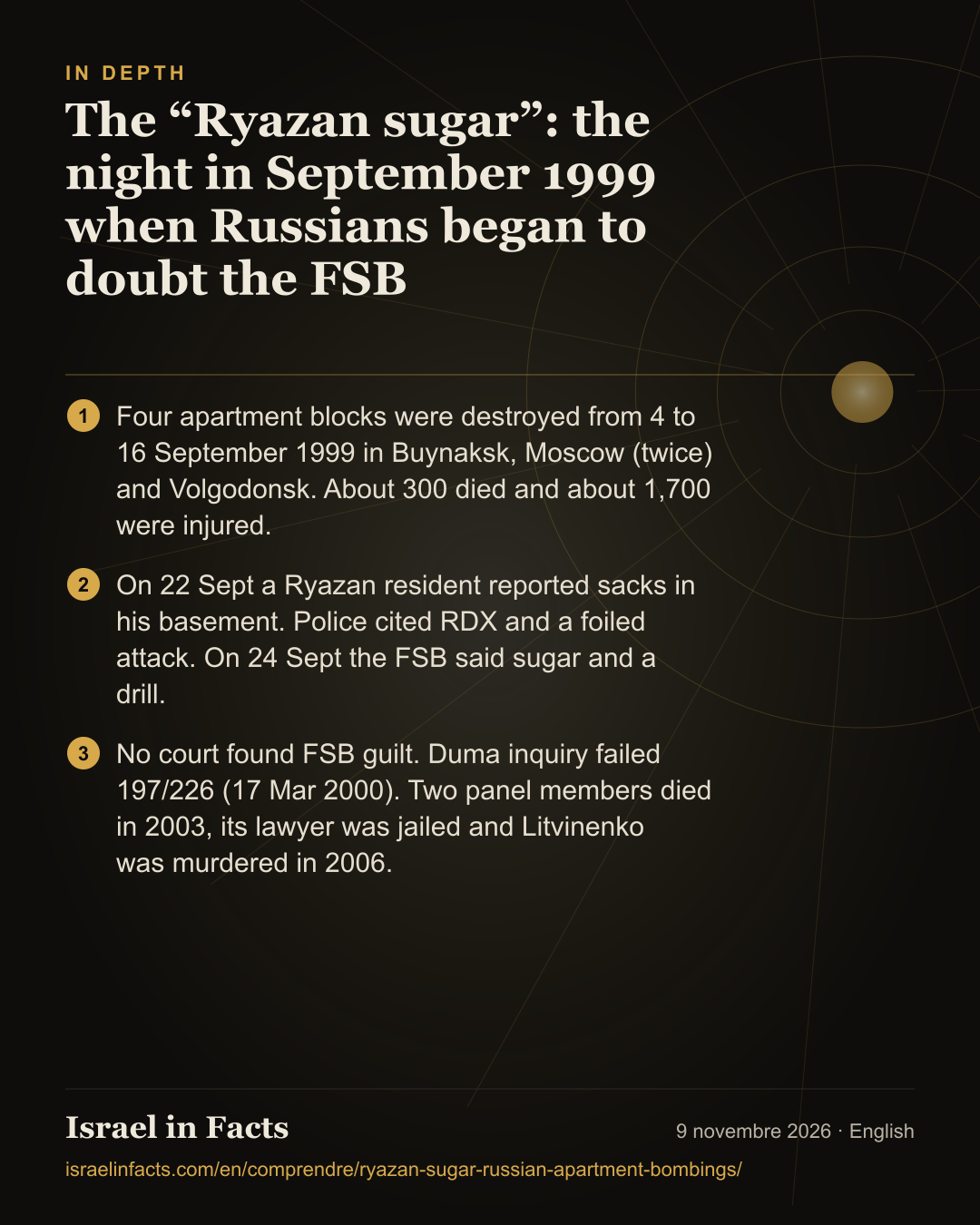
- Four apartment blocks were destroyed from 4 to 16 September 1999 in Buynaksk, Moscow (twice) and Volgodonsk. About 300 died and about 1,700 were injured.
- On 22 Sept a Ryazan resident reported sacks in his basement. Police cited RDX and a foiled attack. On 24 Sept the FSB said sugar and a drill.
- No court found FSB guilt. Duma inquiry failed 197/226 (17 Mar 2000). Two panel members died in 2003, its lawyer was jailed and Litvinenko was murdered in 2006.
Spotted an error or a missing source? Write to us : we publish corrections in the article.
Related reading
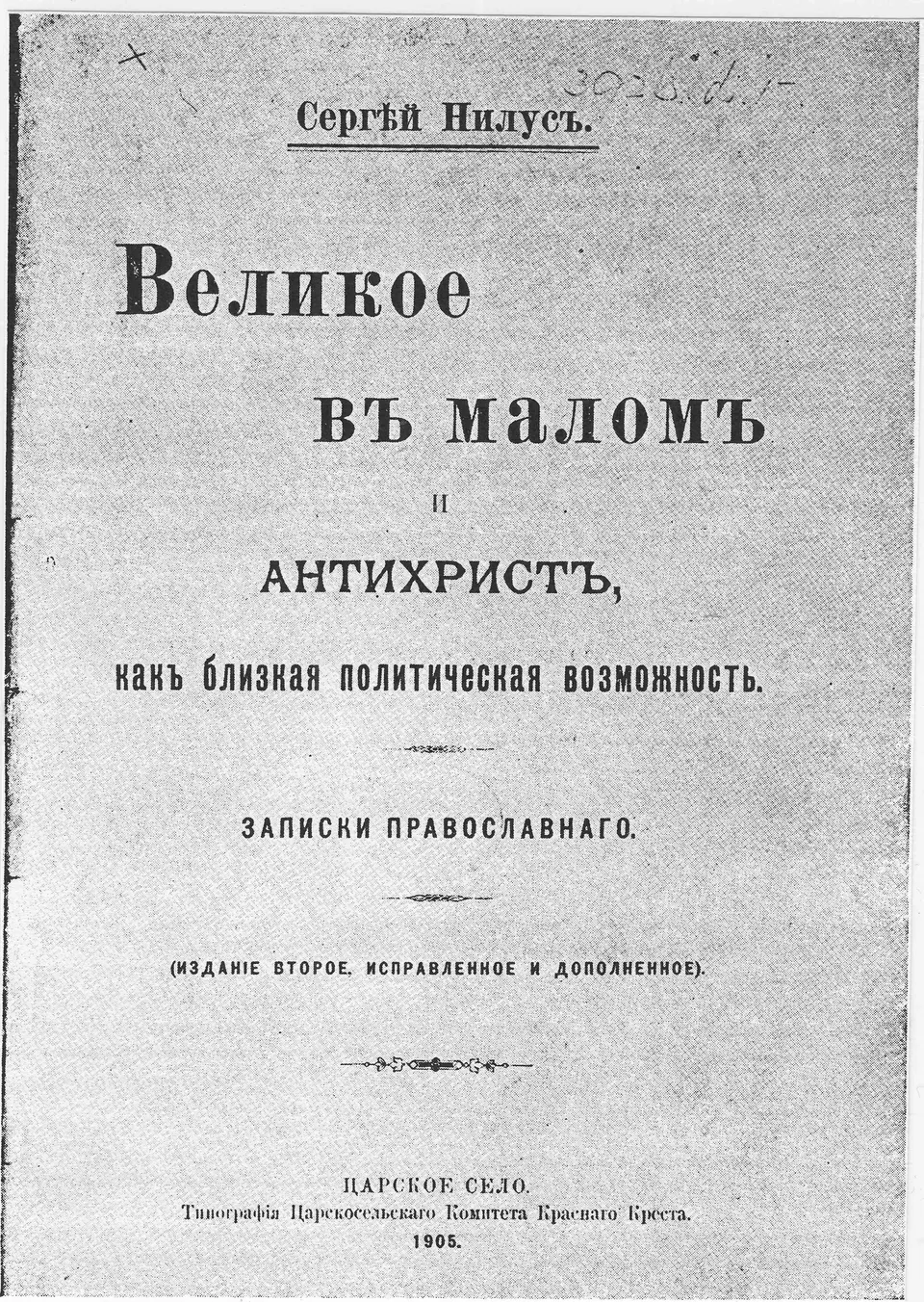
The Protocols of the Elders of Zion: how history’s most widely circulated forgery survived
How were the Protocols of the Elders of Zion exposed as a forgery? The trail leads back to Maurice Joly’s pamphlet and the investigation The Times published in 1921.
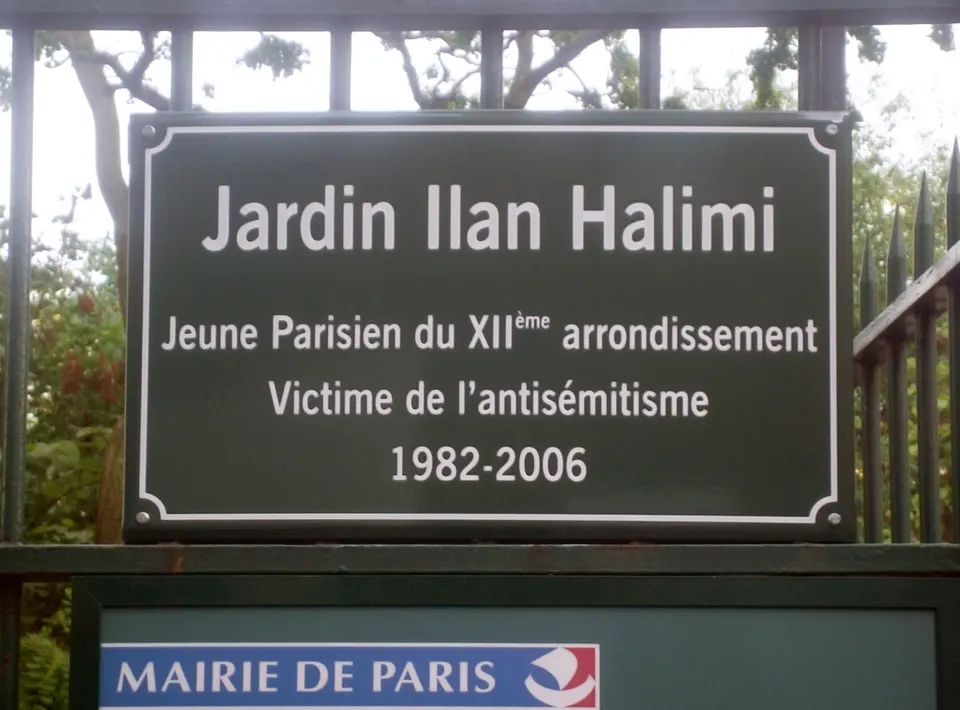
A “first” in Trappes? Fourteen years earlier, three Jewish children were murdered in Toulouse
Gabriel, Arié and Myriam were killed in Toulouse in 2012. How do court judgments and public tributes bear on Macron’s remarks in Trappes in 2026?

Dan Bilzerian says he is criticising Israel. In 2011, he was already blaming Jews for 9/11
From poker to a Florida primary, what Dan Bilzerian has said about Jews and the Holocaust, as documented in broadcasts and archival material.